 |
|
|
|
|
 |
|
|
|
EHV/HV Transmission in India (Build, Own & Operate Basis) |
|
|
|
Project Management services for Transmission / Sub Transmission /
Rural Electrification |
|
|
|
Overseas EHV / HV Transmission |
|
|
| After successful completion of the first Inter-state Transmisison Line
Project (400 kV D/C Tala Transmission Project) on BOOT basis, through first Public-Private
Partnership, the Powerlinks has ventured into new business areas viz. Project Management
Consultancy & Inspection Services. ... more |
|
|
|
|
|
|
 |
|
 |
 |
|
|
|

Dear Colleagues,
A very Happy New Year to all the employees and hope this year will be safe and sound for all of us. Hope we all make the upcoming year a successful one with our hard work, dedication and active participation in boosting the overall growth of our organisation. .
The year 2021 brought Tata Power many firsts-Green Power to our customers; expansion to our Transmission business; lighting up the entire state of Odisha by reaching over 90 lakh households, offering reliable network better reach, technology and customer experience. And more importantly welcoming & embracing change through Parivartan Ru Pragati demonstrating leading Practices in Employee Engagement and becoming the Supplier & Employer of Choice..
Today as we look ahead to 2022, we hope for a brighter year of stability, growth, fulfilment and more accomplishments with Health & Safety as our priorities. I am confident that we will continue to focus on delivering value par excellence to our consumers and create sustainable value to become Utility of the Future.
To successfully move forward in 2022, firstly, we need to continue our dedicated focus on SAFETY & ETHICS as pillars of our basic foundation. Secondly, we need to find new growth Business Opportunities both in Transmission and ERS/Consulting. Also the year 2021 has been a really crucial year for Powerlinks while opening up opportunities in digital transformation and for implementing many innovative projects viz. Drone, Patrosoft…etc.
As stressed earlier, every employee should use the opportunity to develop their own personal skills through Gyankosh and other online platforms with the aim to enhance not only their own ability but also strengthening the talent development pool of Powerlinks and Tata Power Group as a whole.
Throughout 2021, Powerlinks Team has carried out Jan Shayata Abhiyan-CSR and extended help and support to marginal communities in our line of operations area, we plan to continue these worthwhile endeavours working hard with local communities & villagers to help those less fortunate than ourselves.
Various notable advancements in the year 2021 have supported our stability and performance during the time of the global pandemic. Every team member deserves a special note of thanks for their role in supporting us through such a tough time. Building on the strengths of our technical capabilities and your support, we want to step in the year 2022 with many new aspirations.
Warm wishes on New Year 2022!! Kiran Gupta
CEO & ED
Powerlinks Transmission Ltd.
|
|
|
|
 World Environment Day is celebrated on 5th June 2021 and the theme of this year is 'Ecosystem Restoration'. Pakistan is hosting this year's World Environment Day.
Ecosystem restoration is about recovering degraded or destroyed ecosystems and also conserving healthy ecosystems. Restoring ecosystem also reduces the chances of spread diseases like Covid-19, so it is a win-win situation for people and the planet. Ecosystem changes are caused by factors like overexploitation of natural environment, destruction of habitats, invasive alien species, extinction of species etc. If we do not save nature now, we will not be able to achieve sustainable development.
World Environment Day is a reminder that we must take good care of our surroundings. Let us make a promise to make our planet greener and healthier place for us to live and also let us give our coming generations a healthier and happier environment to have a beautiful life.
Best wishes on World Environment Day!! Kiran Gupta
CEO & ED
Powerlinks Transmission Ltd.
|
|
|
|
Dear Colleagues,
Hope you all are with good health along with your
families at office as well as home. The COVID-19 situation has evolved further and we are
dealing with a significant global challenge. In addition to the immediate and
grave health concerns, we are seeing a much wider impact on all of our lives as
well as the global economy.
First and foremost, I would like to thank you for the
24x7 non-stop support provided in last financial year amidst COVID crisis for
the company and ensuring more than 99.9% Line availability with total safety.
Your commitment makes all the difference and I am sure that the way we
performed last year, we are well prepared to cope with the present situation
and would successfully continue operations.
It is in times of crisis that HEROES are born and with
all modesty, I want TATA values to shine at this difficult hour and we all
learn to convert the challenges to new opportunities. I fully recognize that we
are busy managing challenging situations both at personal/family and office
front. This is the moment for an extra effort, for going the extra mile and I
am fully confident that you are all capable of making the Difference.
To overcome this unique challenge, I request all of
you to stay focused on the three priorities:
First,
the safety of all of us is paramount. We can only make positive contributions
and live our purpose and values if we stay healthy and avoid spreading the
virus.
Second,
Business Continuity is the key driver for our growth and thus we need to be
ready for the storm, in case its hits.
And third, to the extent you can – please provide a helping hand to the
communities around us. Please help them to get through this – it is part
of our values and people will remember. This will be a time when we can be a
true force for good.
This mindset also applies to all of us as colleagues.
Due to our unique culture, we often refer to TATA as a family company. A
challenging moment like this is the time to live family values. Unprecedented
travel restrictions have led to difficult personal and family situations for
many of our colleagues. Your personal caring and help can make a lot of
difference to our colleagues and their families – it will also make us a
stronger and even more united team.
I am proud and inspired by the way our company has
risen to this challenge with flexibility, resilience, courage and a caring
heart. Thank you for your enormous contribution at all times. Let’s work
together across all parts of the business locations to keep going with
self-confidence and energy.
Please, do look after yourselves and your families at
office and home.
|
|
|
|
Message of ED & CEO on Women's Day
|
|
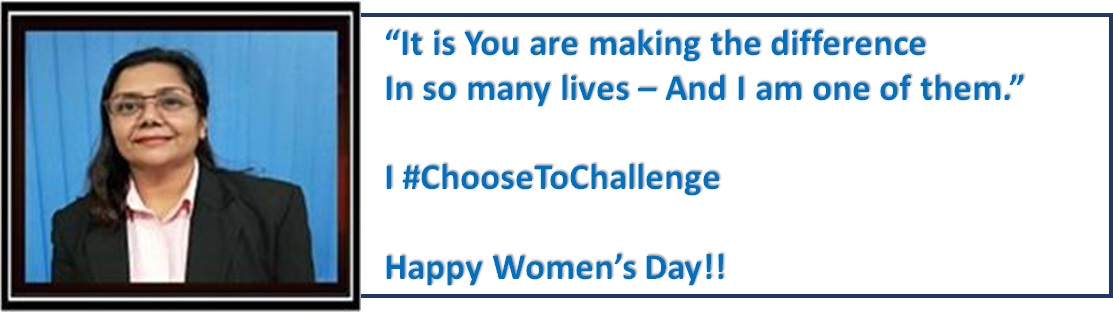
Dear
Friends:
As we celebrate International
Women's Day today, I wish to congratulate all the women of Powerlinks who have
been using their talent across various domains of work to ensure that our
Organization becomes a better place socially, economically and culturally.
I would like to encourage our
women colleagues to not only strengthen their careers using various
opportunities within the organisation and deliver results with passion but also
to live a joyful personal life. At TATA's, we are proud to say that we are
mindful of this and are pushing gender equality across each work area and at
all levels.
At Tata Power, I got the
opportunity to grow as a multi-skilled professional across the value chain and
feel proud today to be the FIRST female CEO in the Company's history. I
took up the challenge of establishing a new Engineering and Specifications
group enabling supply and execution of Best Quality material in an electricity
distribution company. I took up the FIRST operations posting along with
enforcement in the area to bring down the Commercial losses. Subsequently, I
led Customer Services for around 7 mn consumers in Delhi and managed a
successful era of Digitalisation and Technology adoption ensuring efficient
service delivery and Customer engagement. Definitely the journey has been full
of challenges as balancing a family and career is not an easy feat but quite
POSSIBLE with self commitment.
Let us show our love and
gratitude for the women around us always. A special thank you too to all
who are helping to create a more gender inclusive environment to make it easier
for our women to shine through.
HAPPY
WOMEN'S DAY !!!
|
Senior Leadership Connect
|
|
Senior Leadership Connect with Site Officers of Powerlinks
Transmission Limited
SAMVAD
- Simple,
Authentic, Meaningful, Valuable, Articulate, Discussion with CEO & ED
SLOGAN – Create Agile, Connected and Performance oriented,
Future Ready Workforce

Human connections matter more
than any of us ever suspected. Our emotional intelligence shapes our behaviour,
our relationships, our most important decisions and even our
profits/success stories of the organisation. The ability to build
critical connections can bring more meaning to the world of
work. Connected Leadership creates agile, collaborative,
customer-centred businesses that are responsive to change. It’s about leading
through influence and engagement. OBJECTIVE OF LEADERSHIP CONNECT: Drive
culture of Performance and Safety
· Monthly Key highlights of
O&M Maintenance – Team work matters
· Enabling team to feel more
empowered & Effective
· Encourage Job Progress -
Providing challenging opportunities, guidance and support required
· Set clear goals, plans, and
milestones on projects to ensure common understanding
· Appreciation – Reward &
Recognition FREQUENCY: Once
a Month
Platform: All sites to be connected on VC (MS TEAM)
Participants: Site Heads, Head O&M Plus all HODs at Corporate office
KEY FEATURES OF SAMVAD:
Sharing of monthly key highlights by Site Heads
wrt Maintenance, Line Patrolling, challenges (if any), support required (if
any)
Sharing Efforts on generating business leads
Sharing Special initiatives taken towards
Safety
OUTCOME EXPECTED
Engaged & Committed workforce towards
SAFETY
Increased Profit share of the organization
Generating new business leads
LEARNINGS & WAY FORWARD:
Exchange of Thoughts, ideas and best practices
between sites
Generate leads/Deltas for future INNOVATIONs
|
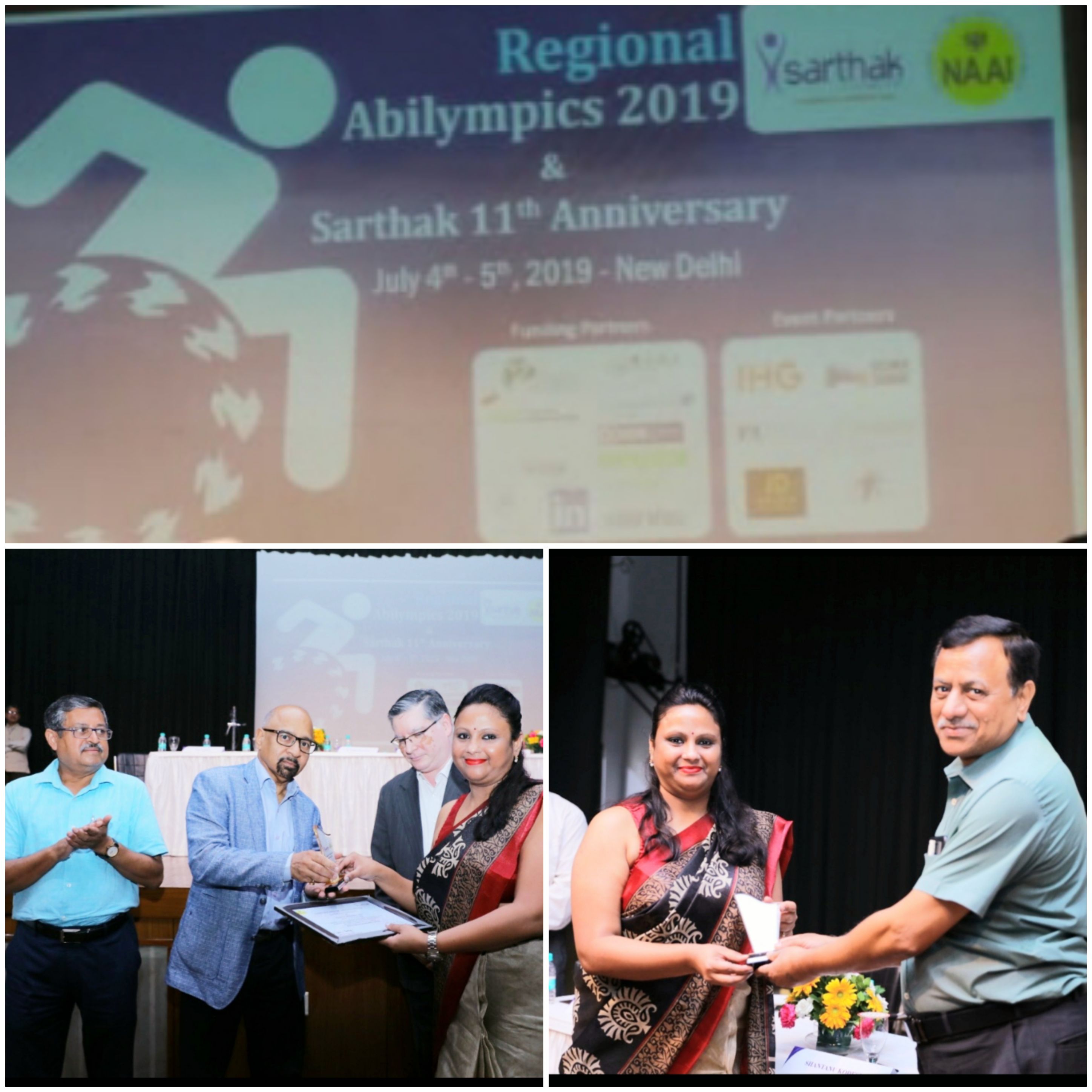
Award By National Abilympic Association of IndiaPowerlinks Transmission Limited has been awarded on 4 july 2019 by NAAI- (National Abilympic Association of India) & Sarthak Education Trust as Catalyst of change' at CSOI, New Delhi for contribution towards inclusion & empowerment of Persons with disability. On behalf of Company, Group Head HR & CSR also presented a short paper on CSR triggering change for specially abled section of the society and inter linkage with the role of human resource function on D&I ( Diversity and inclusion).
|
|
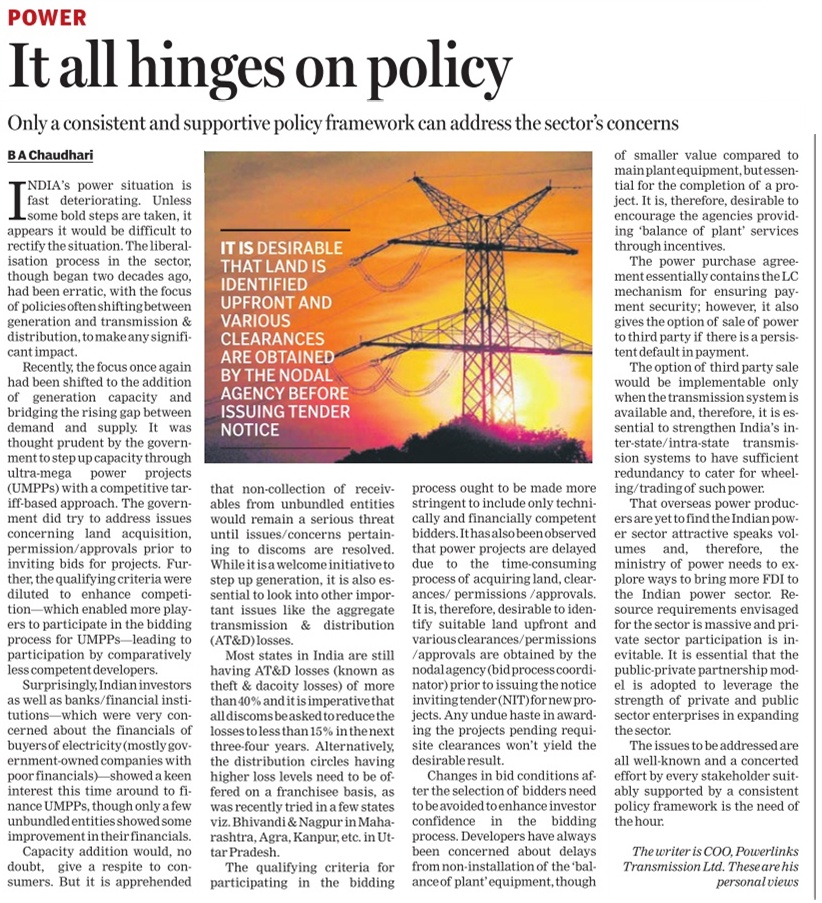
IT ALL HINGES ON POLICY
|
|
By Mr. B A Chaudhari,
Chief Operating Officer
Published in "The Financial Express", Wednesday, August 11, 2010 |
|
|
HOW COST-EFFECTIVE ARE
TRANSMISSION LINES ?
|
|
By Mr. B A Chaudhari,
Chief Operating Officer
Published in "The Financial Express", Tuesday, June 16, 2009 |
|
 The
enactment of the Electricity Act, 2003, brought out several enabling provisions.
Installation of dedicated transmission lines by generating companies or captive generating
plants (CPP) is one of them. This provision has enabled generating companies and CPPs to
establish connectivity with sub-stations or load centres by laying dedicated transmission
lines.
Power being a concurrent subject; both states as well as the
Centre have a role in framing policies and its implementation. Traditionally, the
transmission of electricity within the state is under the purview of the state-owned
companies, which were subsequently notified as state transmission utilities (STU) for
intra-state transmission system. A central transmission utility (CTU) was for inter-state
transmission system. While the central government has taken various initiatives towards
strengthening the inter-state transmission system through private sector participation,
some states that own a large chunk of transmission systems are lagging behind. The
development of transmission systems has to be accomplished in a coordinated manner and in
sync with capacity addition in power generation.
Although the Act provides for generating companies to set up
small dedicated transmission lines to establish connectivity between the generating
station and the nearest grid point for further evacuation of power using intra/inter-state
grid, the IPPs are resorting to set up large transmission lines for dedicated use.
Perhaps, due to lack of initiative on the part of STU/CTU, the generating companies are
compelled to set up a large transmission lines for dedicated use. Recently, one of the
upcoming Independent Power Producer (IPP) in Gujarat succeeded in winning the bid to
supply power to one of the states in the north. It is understood that IPP is laying a
dedicated line between the generating plant and the grid sub-station of the concerned
state. On one hand, India is heading for ‘one nation, one grid’ concept and on
the other, inter-region dedicated transmission systems are being conceived just because
the Act allows for such dedicated lines.
In an integrated grid, power is supplied on displacement
basis by using the transmission system in the most optimal manner. Would it, therefore, be
advisable to allow such dedicated power corridors to be built, which span over thousands
of kilometres? The Act also provides for open access to power transfer and so it remains
to be seen whether dedicated transmission lines of such high capacity would provide a
cost-effective solution.
Moreover, due to scarcity of land, the need of the hour is
to strengthen/ lay regional transmission system that would cater to large number of users,
thereby, lowering the tariff to the end-user. Also, expecting cooperation from
non-beneficiary states for installation of dedicated transmission lines through their land
would be a far cry. In light of the above, it is necessary for all the stakeholders to
review the concept of dedicated transmission lines and help develop and operate the
transmission system in a cost-effective and efficient manner.
The writer is COO, Powerlinks Transmission Ltd. These are his
personal views |
UNRAVELLING
THE TRANSMISSION TANGLE
|
|
By Mr. B A Chaudhari,
Chief Operating Officer
Published in "The Financial Express", Tuesday, April 21, 2009 |
|
| POWER Grid Corporation of India
Ltd. is the only major transmission company in the country to own an inter-state
transmission system. It has a network of around 67,000 circuit km of extra high-voltage
lines with 116 sub-stations and a power transformation capacity of more than 73,000 mva.
Currently, the transmission network handles inter-regional power transfer of about 19,800
mw.
During the 11th Plan, Power Grid is targeting to double its
network by adding around 60,000 circuit km of transmission lines. This would mean an
investment of over Rs 55,000 crore by 2012. This network will support additional
generation capacity of 78,000 mw during the Plan period and double the inter-regional
transmission capacity to 37,700 mw.
The efforts of Power Grid to create a robust transmission
network would need to be supplemented by the private sector. The government took the
initiative to facilitate private sector participation in transmission by bringing about
certain enabling changes in the legal framework.
Thereafter, Power Grid, which was notified as a central
transmission utility, spearheaded implementation of a few projects through the PPP model,
either through the joint venture route or independent private transmission company route.
The Tala transmission project, implemented by Powerlinks
Transmission Ltd, is the first project through PPP and has been successfully operating
since September 2006. Subsequent transmission projects for evacuation of power from
Parbati-II and Koldam hydroelectric projects commenced construction after some initial
hiccups. However, Power Grid ultimately implemented the Bina-Nagda-Dehgam transmission
project — which was to be implemented through the private transmission company route
— for lack of investor enthusiasm. Thus, private participation in transmission has
taken a step back despite the good initial start.
The Electricity Act, 2003, opened the doors for private
sector participation through tariff-based competitive bidding and provided for appropriate
regulatory commissions to encourage competition, efficiency, economical use of resources,
good performance and optimum investments. But even with the enabling policy framework in
place, private investment in the sector in general, and transmission in particular, has
been far below expectations.
Further, under the direction of the Central Electricity
Regulatory Commission (CERC), Power Grid initiated the bidding process for the western
region-strengthening scheme through the private transmission company route in 2005. The
award of the project to the lowest bidder was delayed for various reasons, prominent being
obtaining approval from the PPP appraisal committee and a change in the bidding conditions
with respect to the buyout obligation. The project was further put off due to a delay in
the signing of agreements between the private transmission company and beneficiaries.
Recently, CERC awarded the necessary transmission licence and granted an extension for
completion.
Around two years ago, the empowered committee identified 12
transmission projects for implementation by the private sector. Due to delays in
initiating the bidding process, some of them were handed over to Power Grid so as to
ensure development of the transmission system ahead of the generating stations. While
experimentation is good, the adoption and continuation of a successful model is essential.
There is every reason for optimism about the tariff that emerged through competitive
bidding; however, one also needs to cautiously monitor how many companies can deliver the
projects on schedule.
Thus, it is clear that private sector participation in
transmission is inevitable and it is essential to try out tested models such as PPP for
more projects. This would help private companies gain confidence in implementation of
transmission projects. Unlike generation projects, which are confined to four boundaries,
transmission lines run cross-country and, therefore, face right of way-related challenges.
Though the Electricity Act provides for a licensee to
exercise powers under the Indian Telegraph Act, 1885, if left to a private company, it
would be difficult to circumvent obstructions from owners of private properties as well as
the custodians of public property. PPPs would benefit from the participation of central or
state transmission utilities to obtain the necessary right of way expeditiously for
transmission lines.
Secondly, a lot of inter-phasing would be required between
transmission lines and sub-stations, the latter largely owned, operated and maintained
either by central or state transmission utilities.
Thirdly, the stability of the network would be of utmost
importance and cutting corners for the sake of gaining competitive advantage might
jeopardise the safety and security of the transmission system.
Fourthly, the regulatory mechanism in India has matured
enough to ensure that projects are completed at optimum cost and on schedule. Moreover
fairly reliable benchmark costs are available today for comparison.
Lastly, central and state transmission utilities being stakeholders in PPPs would
certainly guide the private company towards efficient and optimised operation. Existing
PPPs, which have a proven track record, need to be considered for additional projects. The
government may consider amending the existing framework to facilitate such initiatives.
The writer is COO, Powerlinks Transmission Ltd. These are his
personal views |
ENERTIA
AWARDS 2008
|
|
 Powerlinks Transmission Limited has been selected winner of this “ENERTIA
AWARDS 2008” for the construction of the Tala Transmission lines (1166
kms.) from Silliguri in West Bengal via Bihar to Mandola in Uttar Pradesh which involved a
Herculean Task to cast foundations at 10 locations involving 160 Piles (37 Mtr deep. 1200
mm dia. 40 Pile Caps) in the River bed and its completion in 4 months. The project would
Inter-regional power transfer capacity of 3000 MW and this Phase-1 of the Transmission
scheme will finally import 3000 MW of electricity via Bhutan.
Powerlinks Transmission Limited has been selected winner of this “ENERTIA
AWARDS 2008” for the construction of the Tala Transmission lines (1166
kms.) from Silliguri in West Bengal via Bihar to Mandola in Uttar Pradesh which involved a
Herculean Task to cast foundations at 10 locations involving 160 Piles (37 Mtr deep. 1200
mm dia. 40 Pile Caps) in the River bed and its completion in 4 months. The project would
Inter-regional power transfer capacity of 3000 MW and this Phase-1 of the Transmission
scheme will finally import 3000 MW of electricity via Bhutan.India's Awards for
Sustainable Energy & Power declared
Gujarat Wins Award for Best State in Energy & Power Infrastructure. BHEL Sweeps
Thermal Power Awards as K.Ravikumar, CMD wins Individual Award for sector contribution. J.
P. Gaur, Chairman, Jaypee Group Wins "Lifetime Achievement Award"
Mumbai, 25th November 2008: Enertia Awards 2008, India's Awards for Sustainable Energy
and Power were declared here in Mumbai at a grand awards function attended by captains,
CEOs and top professionals from the power and energy sector. 22 awards were declared
comprising of Segments -Hydropower & Green Energy, Thermal Power, De-Centralized
Energy, Transmission & Distribution, Best Performing Utilities etc. Also 3-Individual
Contribution and one Lifetime Achievement Award, plus the Award for Best State Government
/ State for Excellence in Power and Energy infrastructure were the highlights of ENERTIA
AWARDS 2008.
State of Gujarat won the award for "Best State Government for Excellence in Power
and Energy Infrastructure". BHEL's – Haridwar facility won the award for
Technology Innovation for Power Generation in Thermal Power for its state-of-the-art
Supercritical Turbomachinery and Blade facility. Chairman and MD, BHEL, K. Ravikumar
received the Individual contribution to sector award for Thermal Power. Speaking on the
occasion Mr. Ravikumar acknowledged the Jury Panels decision and said that he would
continue moving BHEL to the target of 50,000 MW of Power Generation machinery production
capacities by the end of 11th Plan. J. P. Gaur, Chairman, Jaypee Group received
"Lifetime Achievement Award" for contribution to India's Power and Energy
Infrastructure sector. Dr. D. G. Kadkade, Chief Advisor, Jaiprakash Associates Ltd,
received the winner's award for Individual contribution to Power Generation in "Large
& Medium Hydropower". S. M. Trehan, MD Crompton Greaves Ltd, received award for
Individual contribution to the Transmission and Distribution sector.
Bhutan's Tala Hydroelectric Project won the Enertia-Patel Engineering Hydropower and
Green Energy Award for being "Special Project in SAARC region impacting India's
Strategic Power sector plans". In the same segment, 'Satluj Jal Vidyut Nigam Ltd',
the owner of Nathpa Jhakri project in Himachal Pradesh won the "Business Excellence
and Financial Engineering" Award. Receiving the Award, Chairman and Managing Director
of SJVNL, H. K. Sharma said that the Nathpa Jhakri Project was the best performing
Hydroproject in the country over the last two years. The project is also India's largest
operating hydropower project with a capacity of 1500 MW. In the small hydropower sector,
Subhash Projects and Marketing Limited won the Award in the category Project Management
for its 20 MW Kabini Small Hydroproject in Karnataka completed in record time of 20
months.
In the segment "Best Performing Utilities" the awards went to APGENCO (Andhra
Pradesh Power Generation Corporation Ltd.) in Power Generation and to DGVCL (Dakshin
Gujarat Vij Company Limited) in Transmission and Distribution. NDPL (North Delhi Power
Limited) was declared Winner for being the "Best Urban Utility" in the
Country.
In the Segment "Other Renewables-Solar Energy", the TATA BP Solar Chattisgarh
Village Rural Electrification project was declared winner for being the pioneering project
currently electrifying 275 villages in Chattisgarh using Solar Power. DLF
Utilities Private Limited received the Award for Project Management in De-Centralised
Energy for its Urban Building Utility-Combined Heat and Power (CHP) plants while Thermax
limited received the Award for Business Excellence and Financial Engineering in the same
category. Rural Electrification Corporation was declared winner in the same category
for the Transmission and Distribution Segment. Siemens limited, one of India's
leading power sector companies and a global leader won the Award for Technology Innovation
for the Talcher-Kolar HVDC link capacity enhancement. The other winner in this T&D
segment was Powerlinks Transmission Limited for The TALA Transmission Link Project. In the
Oil & Gas segment the clear winners were Reliance Industries Limited for Project
Management in commercialization of RIL-KG Basin Gas find in record time and Cairn India
Limited in Technology Innovation for the Exploration and Production technique
deployed in their Rajasthan Oil and Gas fields which are poised to fulfill 25 % of India's
crude oil demand in the year 2009. Ambuja Cements limited won the Award for being
the most Energy efficient operator in the Cement and Core sector.
ENERTIA AWARDS 2008 were judged by an Eminent Jury Panel headed by R. V. Shahi, Former
Secretary Power, Government of India and other Jury Panel being: Prof. A.G. Iyer,
President-Falcon Strategic Advisories (India) and Editor-in-Chief, ENERTIA Journal; C. P.
Jain, Former CMD, NTPC Limited; T. C. Arora, Former Director-Toshiba India; Y. N. Apparao,
MD, Teesta Urja Limited , Awadh B Giri, Former CMD, UJVNL. |
|
PROJECT
MANAGEMENT CONSULTANCY ASSIGNMENT FOR JSW ENERGY LIMITED
|
|
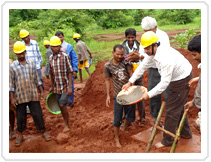 JSW Energy Limited appointed the Company for providing project
management consultancy assignment for implementation of the following 400 kV D/C TL: JSW Energy Limited appointed the Company for providing project
management consultancy assignment for implementation of the following 400 kV D/C TL:
- 400 kV D/C Jaigarh - New Koyana Line (QUAD MOOSE)
- 400 kV D/C Jaigarh - Karad Line (QUAD MOOSE)
The above lines would facilitate evacuation of power from 1200 MW Thermal Power Project
being set up at Jaigarh in Ratnagiri District of Maharashtra.
PwC has been retained by JSW Energy Limited for advising them on commercial issues.
Recently, the tendering process was completed for above lines and L & T has been
issued letter of acceptance of their proposals for both the lines. Necessary Letter of
Awards being issued. Meanwhile, all outstanding technical/ commercial issues were resolved
with L & T, during the pre-award discussions held on 8th July 2008.
L & T has commenced mobilization w.e.f. 9th July 2008. The Company has also
commenced mobilization and posted our Project Manager for establishing the site office at
Chiplun. The foundation work has commenced on both the lines. |
|
CONSULTANCY
SERVICES TO WORLD BANK (WB)
|
|
WB has appointed the Company for providing technical
assistance in respect of the following:
- Review of bidding documents (RFQ &: RFP) for procurement of equipment / EPC
services by Haryana State Electricity Board
The Company has reviewed the Standard Bidding Documents (SBD) prepared by HVPNL and
provided valuable comments/ suggestions to make the documents as comprehensive as
possible.
The SBD is in the process of final approval from the World Bank. |
|
MORE
POWER TO THE PEOPLE
|
|
| The 26th of August 2006 was a historic day for the Power
Sector in the Country when the Northern Grid and Central Grid were synchronized
successfully creating another historic occasion to celebrate. For POWERLINKS team it was a
day to rejoice as the efforts of last two and a half years resulted in completion of the
Tala Transmission System within the time schedule, which helped synchronization of the
Central and Northern Grids making it one of the largest Synchronous Grid in the World.
This is one major step towards "One Nation One Grid". The Journey that started
sometimes in July 2000 with the selection process for the Joint Venture for execution of
the prestigious Tala Transmission System has borne the fruits more that expected.
POWERLINKS TRANSMISSION LIMITED takes the pride for having created the first ever
Transmission System with Public and Private partnership, thereby paving the path for
Private Investment in the Transmission Sector.
Powerlinks has not only executed the Project in time and within the Budget but has set
the highest standards of Quality in the Transmission Projects and has become the 'Role
Model' in this Sector. Today the entire team of Powerlinks is highly motivated and charged
after the successful commissioning of the Tala Transmission Project and is ready to take
up many more challenges and do even better job and set a benchmark for others to follow. |
|
| THE TRANSMISSION SYSTEM SHOULD FACILITATE : |
 |
Evacuation of Power from the 1020 MW Tala Hydro - Electric Power Project
in Bhutan to Eastern Region. |
|
Transfer of surplus power from Eastern Region to Northern Region through
East - North Inter- Connector and Northern Region Transmission System. |
|
Creation of a transmission highway or an artery for transfer of Power to
Northern Region including Delhi from upcoming generation Project in North - East Region. |
|
Would form a part of the National Grid. |
|
|
| Corporate societal commitments have been forefront with the Powerlinks
team while executing the Project. Powerlinks has taken several initiatives to fulfill such
social commitment some of which are : |
|
|
|
Quick Payment of crop and tree Compensation |
|
Least damage to trees buy increasing tower height and modifying tower alignment where
possible. |
|
Safety training programmes for transmission line workers at all Site Camps. By using
various mediums of communications such as movies, safety talks, safety manuals and other
aids, workers of contracting firms were made aware in ways they could understand and
relate to. |
|
PTL also conducted health awareness, HIV awareness and family planning programmes at
Site camps in collaboration of an NGO. |
|
Local labour employed by Channel Partners |
|
|
| A great event in the Corporate history of our Country - a giant leap for
those whose lives will be touched and bettered through this project ! For about 20 Crores
consumers in Delhi, Haryana, U.P., Bihar, Rajasthan, Punjab and Jammu & Kashmir, life
is definitely going to better and more comfortable than before with the additional power. |
|
|
 |
|
|
|
|
| Copyright 2009 © Powerlinks Transmission Limited- All
rights reserved. |
|
|
| | | |


